If Social Media is Cigarettes, Maybe Group Chats Are Vaping
no-ai-use manage-thyself wild-ideas modest-proposal
I had the common 2020 experience of scrolling infinitely on Facebook and Twitter, then feeling worse for having done so. Eventually I had the sense to quit these platforms. Years later, it dawned on me that private group chats have many qualities of social media, beyond just connecting you to other people. While there is (typically) no advertising or adversarial-to-the-user content curation, I still feel impulses to:
- Drop whatever I’m doing to check for new messages, especially for replies and reactions to my own recent messages.
- Send low-effort GIFs, memes, or joking-but-ambiguously-serious messages that pollute the information commons (despite feeling smug at the time).
- Have disagreements in group chats with friends.1
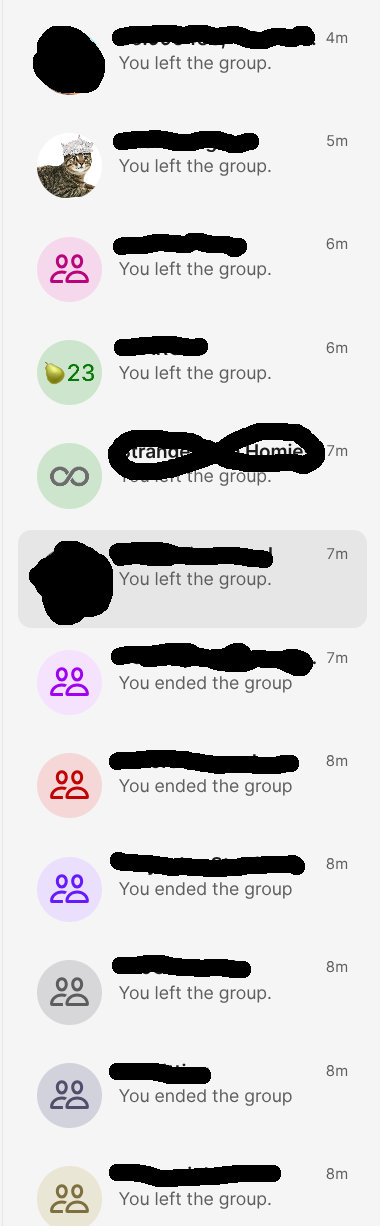
After noticing that my digital home was full of information candy2 that I couldn’t stop compulsively eating, I mixed it with cat poop and took it outside departed many group chats today, including chats that I personally started and grew over a period of years.
Few things are entirely bad, so yes, I am trying to have it both ways. I remain very open to:
- One-on-one messages with anyone.
- Small groups of close friends (probably four at most including me).
- Group chats whose sole purpose is planning in-person activities.
- Group chats with rules (or strong norms) about staying on-topic and not polluting the information commons.
I’m unsure what to do about the Slack and similar workspaces for volunteer and community groups that I’m active in. For now, I guess they’re okay if I can look at them only in a web browser, only after typing a long password to temporarily relax my blocking rules, and there are no push notifications.
FAQ for Friends
You don’t want to talk to me anymore?
Not the case! I still welcome one-on-one conversation with you. Please message me any time.
You completely ended (particular group) instead of just leaving it, why?
I did this for groups that (1) Signal would not allow me to merely leave (without designating someone else as an administrator), and (2) had no recent activity (several months or years). Please feel empowered to create a successor group with the same members.
I still see you in (particular group), why?
One of two reasons:
- I decided it was worth the tradeoff (per the list above).
- I sorted my groups by most recently active, started at the top, and gave up around 3 years since the last activity.
If private group chats are this bad, does this mean that the harms of mainstream social media are overstated?
Interesting to think about, but no, I don’t think so. See post title.
What does this mean for workplaces that use a chat platform like Slack or Teams?
Whole books try to answer this! At risk of over-scoping a blog post: I think that most activities within an organization belong to one of a few common ‘shapes’, and it’s worthwhile to build (or customize existing) structured information systems to process each shape of activity, and automate what you can while reducing interruptions, noise, and ultimately burnout in a McLuhan-aware way.3 (For certain professions, there’s a ‘standard’ set of systems such as issue tracker + git + pull requests, and you should have a good reason to stray from these.) In the limit, your organization’s chat will be low-traffic, catching occasional things that don’t fit the information systems.
Yes, these orgs actually exist. I’ve had the pleasure of working at or leading two-ish of them.4 I’ve also experienced the chaos of a team whose collective mind is a stream-of-consciousness Slack workspace, maybe with the occasional Google Doc, and also one or two places in between these poles. There is such a thing as too much structured process, but I think most groups who use Slack or Teams are locally incentivized to under-build this and rely too much on chats.
On Rate-Limiting Text Conversations
Yesterday, a friend indirectly raised the question of how to handle someone who sends more text messages (perhaps signalling more interest in you) than you have the appetite for.
I believe that, with a few obvious exceptions (like one’s partner), you don’t owe your interlocutor a response on any particular timeline. Waiting a day to respond should not require an apology or excuse. One could see this as playing a signaling game, sending a meta-message of “I’m less interested than you are in this conversation” (without having to explicitly say that), but I don’t necessarily agree. It can be authentic (in a non-meta-signally way) to decide that prompt texting is not among your life’s prorities, and to set your habits accordingly. It doesn’t intrinsically mean that you don’t value someone or don’t want to hear from them. A reply 1-2 days later can be more thoughtful and considered than a reply in the moment. Also, you’re allowed to make exceptions and reply in the moment sometimes. Also, snail mail used to take months.
I think the best version of myself would silence message notifications on my personal devices and look at them only twice per day: in the morning (after exercise, not immediately upon waking) and maybe in the evening while winding down. Obviously more if I’m coordinating an in-person meeting with someone, but failing that, it can wait until later and they’ll call if it’s urgent.
Corollary: I believe that message-read indicators are corrosive to relationships. I turn them off anywhere that has them by default.
Having written all this, I fear it all sounds sociopathic or un-caring. I continue to value other people and interacting with them, as much as ever! I just think that our most often-used communication tools, by structure and default configurations, don’t bring out the best in us, certainly not the best in me. When we recognize this, we should feel unafraid to set boundaries around the tools.
-
For most sorts of friends and disagreements, I regret having prosecuted even slightly-emotionally-charged disagreements in a group setting. This seems harmful regardless of which you value more, the relationship with your friends or the relationship with the truth underlying the argument. ↩︎
-
Andrew Backhouse’s junk food addiction framing for compulsive internet and social media use feels intuitively right to me. ↩︎
-
Also, hopefully you avoid platforms that enshittify underneath you and fracture your team’s attention (e.g. with pulse-animated buttons begging you to try this new feature). Slack, Discord, Jira, and Microsoft Teams/365 are unfortunately all on my shit list here. ↩︎
-
I’m not naming names, with the exception of Exosphere, where I think we struck a great balance. I also have fond memories of a small defunct consultancy whose internal chat banned GIFs and memes, except for within a single channel that you could mute or leave. ↩︎